
100% completion is not a result: how to tell whether safety training works
A report of completed courses proves the training took place, not that work on site has changed. Here is which measures to add and how to collect them without burying the HSE team in paperwork.

Almost every industrial company has a report showing mandatory occupational safety training at 100%. That figure matters: under the Labour Code of the Republic of Kazakhstan, employers must provide training, instruction and knowledge checks for their workers on safety and labour protection. But completion answers the question "has everyone done it?", not "do people now work more safely?".
The international standard ISO 45001 goes further. Its clause on competence asks an organisation not only to provide training but also to evaluate the effectiveness of the actions taken. Below is a practical way to do that.
Four levels of evaluation
A convenient framework is the model Donald Kirkpatrick proposed in the late 1950s: reaction, learning, behaviour, results. In HSE, each level translates into concrete measures.
Reaction. A short survey straight after the course: was it clear, does it apply to your area of the site? This is not yet a measure of effectiveness, but it is an early signal that content is out of date or written for a different job.
Knowledge and skills. A test before and after the course shows the gain, not just the final score. The most useful view is the questions a whole crew or shift gets wrong: that is the topic of the next toolbox talk, ready-made. Practical skills are checked on a simulator or an equipment mock-up: did the person carry out the procedure in the right order?
Behaviour on the job. Safe-work observations, permit-to-work checks and adherence to lockout/tagout (LOTO) a few weeks after training. This is where you see whether a skill has made it from the classroom to the site.
Results. Leading indicators: the number of near-miss reports, the share of corrective actions closed on time, the findings of behavioural audits. Lagging indicators: injuries and incidents. They matter, but they are rare and driven by many factors, so they cannot prove the effect of training on their own.
How to set up the measurement
Record a baseline. Without a measurement taken before the programme starts, there is nothing to compare against.
Pick two or three metrics, not twenty. For example: the test gain, the share of non-compliances in observations, and the number of near-miss reports from the area.
Compare like with like. An area that has completed the new programme with one that will take it later; the same shift before and after.
Set a time horizon. Knowledge is checked at once, behaviour after one to three months, results over a quarter or longer.
Connect the data. Training results sit in the LMS, observations and incidents in the HSE system, headcount and positions in HR. Until they can be matched by employee and department, "did it help?" has no answer.
Common mistakes
Treating a pass mark as proof of competence. A test everyone passes at the first attempt measures nothing.
Crediting a drop in injuries to training alone when equipment, contractors or workload changed at the same time.
Collecting data nobody uses. Every metric should lead to a decision: update the course, repeat the briefing, strengthen mentoring.
How DEQR helps
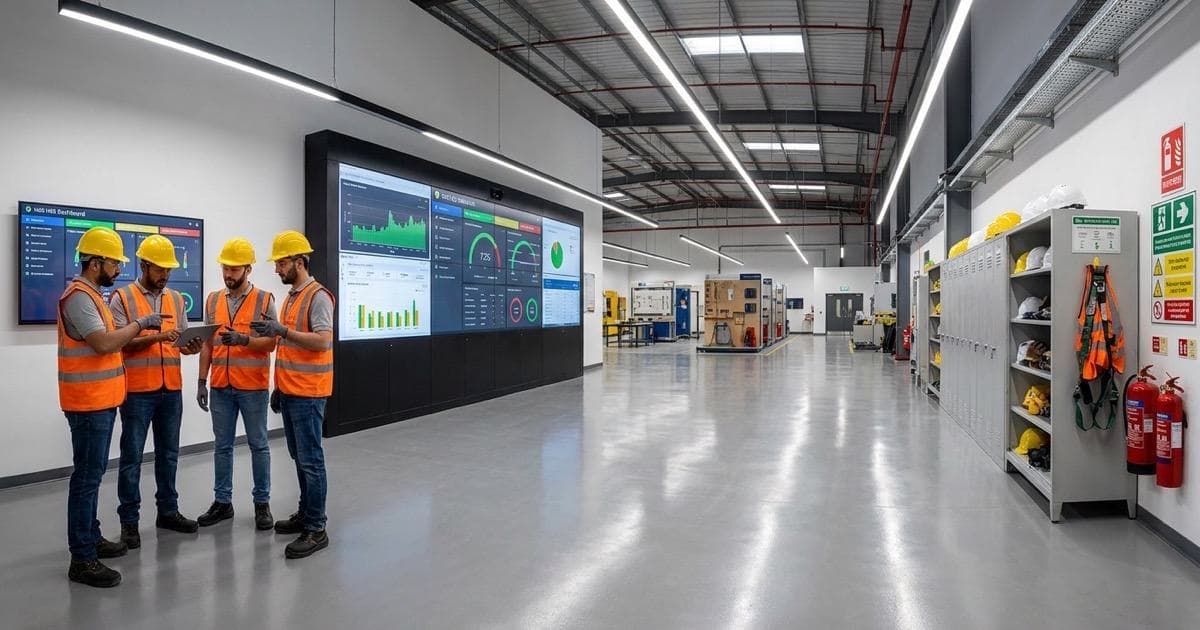
We build LMS and white-label HSE platforms with one dashboard across all branches: who has completed training, whose clearance is about to expire, and where the competence gaps are, with integration into SAP, 1C and HR systems. For hands-on skills, we develop 3D, VR and AR simulators built around a specific plant's processes. We will show you how to set up the measurement on your own data.
Book a DemoRelated Articles
White-label platforms for HSE: why companies brand their training systems
Ready-to-deploy training platforms under your own brand for occupational health and industrial safety. How they work and why they beat building from scratch.

How LMS is transforming corporate learning in 2026
Learning management systems have become a key driver of workforce development. We break down the 2026 trends and what to look for when picking a platform.